Welcome Prof. Dr Fabian Michl, Cross-border professor in Eucor!
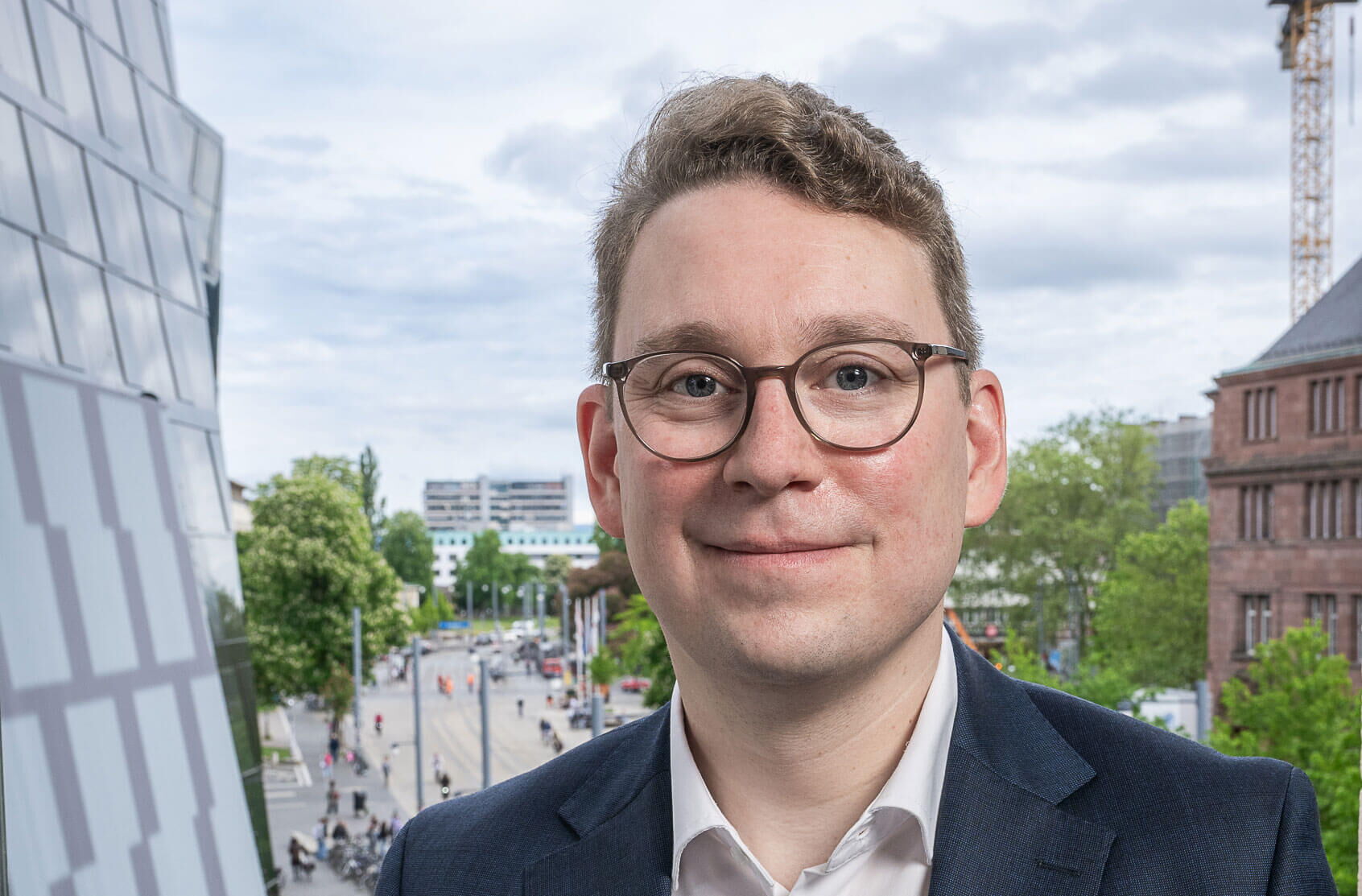
The Faculty of Law of the University of Freiburg has appointed Fabian Michl Professor of Public Law. His Eucor cross-border professorship is designed to strengthen Franco-German cooperation within Eucor. Michl explaines in this interview how this works.
What do you really enjoy about your research?
My focus is on constitutional law, constitutional theory, and constitutional history. Constitutional law is a dynamic area of law, with close ties to the political system and its present-day challenges. Combining constitutional law with the other two fundamental subjects allows me not just to analyse current developments in constitutional law and politics, but also to classify them from a theoretical and historical perspective. I find these multiple perspectives very stimulating.
What solutions can you find in your research for challenges now and in the future?
Above all, I am currently studying how the law can contribute to the success of democracy. I examine how legal norms can create a framework in which majorities are formed and minorities protected, with a balance between government and opposition, and in which in the end democratic decisions are taken. When one thinks of the law, its restrictive function is often the primary concern. But from a democratic point of view, what interests me is in fact the enabling function of the law as a ‘law of democracy’.
As the holder of a Eucor cross-border professorship you will be cooperating with the University of Strasbourg in France. How will you organise the content of this cooperation?
The Universities of Freiburg and Strasbourg have already realised several successful projects in the Eucor – The European Campus network, including a two-year dual Master’s in Franco-German law, taken by both German and French students. The Faculty of Law also has the French Law School project, where teachers from Strasbourg give German students an early introduction to French law. I’d like to reinforce these as well as having binational research cooperations. The link with Strasbourg offers great potential for comparative research, but also constitutional theory and history topics: after all, Alsace has a special place in French and German history, and constitutional law has always played a significant part in this. The fact that the European Court of Human Rights, which decides on cases from 46 nations, is based in Strasbourg is an additional incentive.
What would you like to pass on to your students for their future lives, and what do you get from teaching yourself?
I’d like them to enjoy studying law. This requires the students to be interested in law, something that really isn’t that hard, despite the pressure to perform: because law and the study of law touch on almost all aspects of politics and society. So it is well worth once in a while attending events put on by other faculties and making use of interdisciplinary offers such as Freiburg’s Studium Generale. I myself benefit from teaching especially by gaining a healthy distance to my field of research. The discussions we have in the classroom show clearly that many things can be regulated quite differently. When students call into question things that are supposed to be self-evident in existing law, they contribute far more to the success of my research than reading some academic papers.
What subjects are you currently most engaged with personally away from your research?
Since the current challenges to democracy are part of my research, I have to answer that differently: the digital transformation in universities, especially dealing with AI – between hype and suppression. I don’t think it’s the job of legal education to teach prospective legal practitioners to prompt. They are learning that themselves faster than we could establish a course on it. Instead, we have to create spaces where the students still think for themselves and argue. How we can defend these spaces against the AI apologists of our time, that is, against the tendency to overlook the risks of AI, that is what I am most concerned with away from my research.
What are you looking forward to most in Freiburg?
To the exchange of ideas with students and researchers from my own discipline, but also from other subjects. That’s already been going really well, as I can not only see the main building from my office in Werthmannstraße, but also a clear view of the Mensa canteen.
Cross-border Professorships in Eucor
Prof. Dr Fabian Michl holds one of the four current cross-border professorships in the Eucor – The European Campus network; they are largely financed by the Baden-Württemberg Ministry of Science, Research and the Arts (MWK). Following three cross-border professorships at the Karlsruhe Institute of Technology (KIT), Michl is the first cross-border professor based in Freiburg. As strategic tools, the professorships enable the network to strengthen the establishment of bi- or trinational research and teaching cooperations structurally and institutionally. The MWK is financing the professorship shared by the Universities of Freiburg and Strasbourg for six years. It perpetuates the longstanding cooperation between the Faculty of Law in Freiburg with its counterpart in Strasbourg, and aims to reinforce Eucor’s focus ‘European Identities’, build up new projects and prolong existing ones.
Article by University of Freiburg