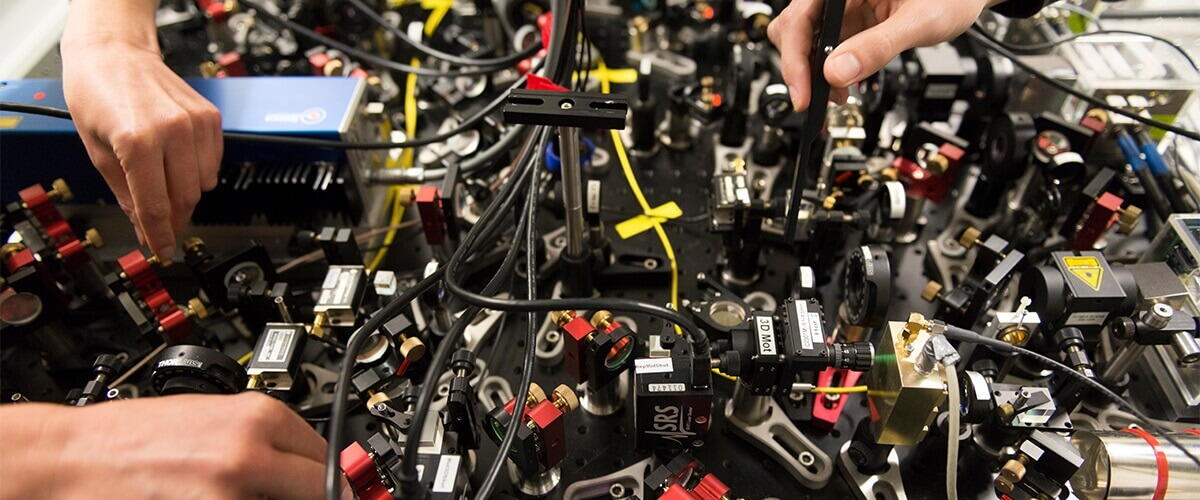
Research in the field of quantum sciences is the prerequisite for the development of key future technologies. Eucor is therefore helping to shape the second quantum revolution and is continuously expanding its strategic focus area Quantum Sciences and Technology. Within Eucor's focus areas, “Research, Teaching and Transfer Hubs” (RTTHs) are being established, which is why they are structured into research, teaching and transfer.
Quantum Sciences and Technology in Research
Joint doctoral programmes
- Gen-Q is a doctoral programme established by the EGTC Eucor – The European Campus. It enables up to 51 early-career researchers to pursue a doctorate with an international, interdisciplinary and intersectoral focus in the field of quantum science and technologies. The EU funds the programme under the Marie Skłodowska-Curie Actions (COFUND). In addition to the five Eucor universities, the universities of Amsterdam and Poznań are involved.
- The programme “Quantum Science and Technologies at the European Campus” (QUSTEC) enabled joint doctoral training from 2019 to 2025. The EU funded the programme, coordinated by the EGTC, under the Marie Skłodowska-Curie Actions (COFUND). Partner institutions were the universities of Basel, Freiburg and Strasbourg, Karlsruhe Institute of Technology, IBM Research – Zurich and the Walther-Meißner-Institut für Tieftemperaturforschung. From 2024, the Franco-German University also supported doctoral exchange in this field.
- The international doctoral programme Machine Learning for Quantum is a collaboration between the University of Strasbourg and Karlsruhe Institute of Technology, with further European partner institutions in Hungary and Italy. The EU funds the programme under the Marie Skłodowska-Curie Actions (Doctoral Network). The Seed Money project Quantum Machine Learning (see below) served to prepare the application.
Cross-border professorship
- In 2022, the University of Strasbourg and Karlsruhe Institute of Technology established two closely networked quantum research institutes and set up a cross-border professorship in the field of Quantum Computing, which is funded by the state of Baden-Württemberg as well as the Région Grand Est and the Collectivité européenne d’Alsace.
Postdoc cluster
-
The Georg H. Endress Postdoc Cluster at the Centre for “Quantum Science and Quantum Computing” (QSQC) is a cross-border collaboration between the University of Basel and the University of Freiburg. The Cluster is a ten-year initiative to support and train outstanding early-career researchers.
Interreg project
- In the areas of teaching, research, specialised infrastructure, technological know-how and knowledge transfer, the Interreg project UpQuantVal (2025–2027) aims to create an integrated and sustainable ecosystem centred on the field of quantum science in the Upper Rhine region. Project partners include the Eucor universities of Basel, Freiburg and Strasbourg, as well as Karlsruhe Institute of Technology.
Seed Money projects
- The Belle2NewPhy project (2019–2021) between the University of Strasbourg and Karlsruhe Institute of Technology included particle-beam experiments in international research laboratories in Germany as well as expert discussions in Japan.
- The Quantum Machine Learning project (2020–2022) between the universities of Basel and Strasbourg and Karlsruhe Institute of Technology focused on the interface between quantum mechanics and machine learning and investigated how findings and techniques from one field could be used to solve the problems of the other. The project also involved preparing the application for the doctoral programme Machine Learning for Quantum (see above).
- The Open quantum many-body systems project (2025–2026) serves to build a network dealing with complex quantum many-body systems. The universities of Basel, Freiburg and Strasbourg, as well as Karlsruhe Institute of Technology, are involved.
Eucor has determined several thematic areas of cooperation to utilise joint strengths and pool competencies. These focus areas were defined after analysing potentials, locations and existing collaborative projects. Based on specific themes, the member universities establish consortia that are capable of conducting internationally visible and competitive research, while maintaining close ties to teaching and innovation. The main focus areas of Eucor are
- Quantum Sciences and Technology
- Personalised Health
- Sustainability
- European Identities.
Within Eucor, the Karlsruhe Institute of Technology coordinates the activities in the Quantum Sciences and Technology focus area.
Quantum Sciences and Technology in Teaching
International certificate
- The EFEQT programme is a one-year supplementary training programme for research-oriented students who are completing their Master’s degree at a European university. It offers accredited training modules and a certificate. In addition to Eucor, Karlsruhe Institute of Technology and the Université de Strasbourg, further partner institutions in Germany, France and the Netherlands are involved.
Transfer of Quantum Sciences and Technology
Joint platform
- The Atomic Quantum Computing as a Service (aQCess) project provides an open, public platform for digital quantum computing based on high-quality atomic qubits. In addition to the University of Strasbourg and Karlsruhe Institute of Technology, numerous international partner institutions are involved.