Experiencing Languages, shaping Europe: A look back
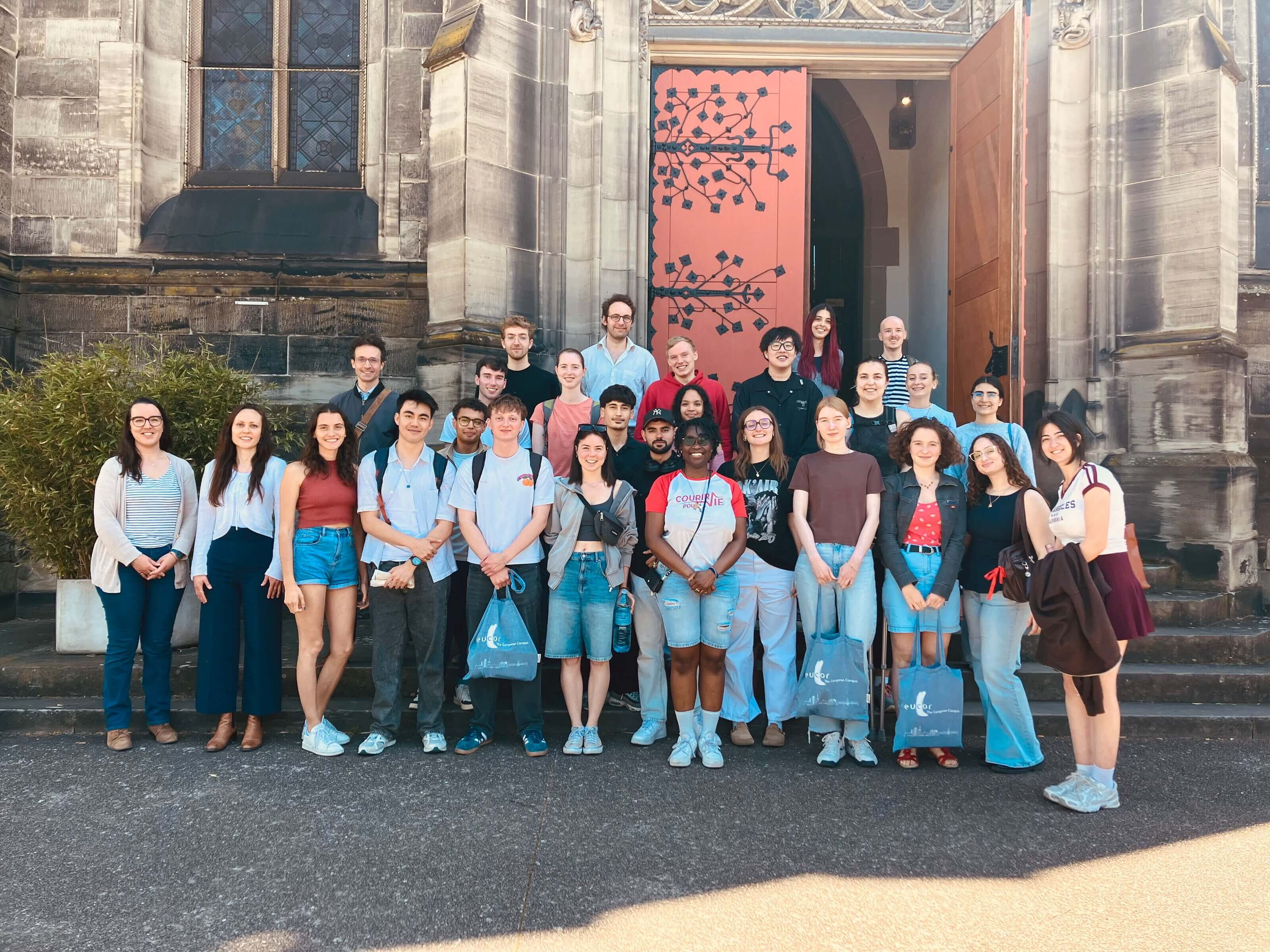

On the occasion of the 10th anniversary of the EGTC Eucor – The European Campus, a one-week language and cultural exchange took place in Strasbourg from 17 to 22 May 2026, bringing together 30 students and doctoral candidates from various disciplines at the universities of Basel, Freiburg, Mulhouse and Strasbourg, as well as the Karlsruhe Institute of Technology. The week focused entirely on Europe and offered participants a diverse programme consisting of intensive French as a Foreign Language (FLE) and German as a Foreign Language (DaF) courses, cultural activities, visits to European institutions, and intercultural encounters that made Europe and its values tangible in a direct and vivid way. The exchange impressively demonstrated how approachable, human and interconnected Europe can be, and how unity in diversity can be lived in practice.
Cultural diversity in a European and international space of exchange
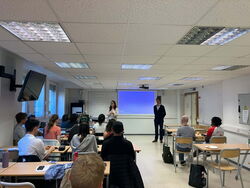
The mornings were devoted to parallel language courses in German and French, led by Louise Bonnin, Gilles Buscot, Maxim Görke and Isabelle Schaller, lecturers at the Department of German Studies at the University of Strasbourg. Each course session focused on a different theme and combined language learning with cultural, social and creative approaches. The main topics included theatre and creative writing, film and music, as well as aspects of regional and cultural studies.
The week began with a theatre workshop, which gave participants the opportunity to get to know one another and grow together as a group. Through playful activities, improvisations and short performances, participants developed their creative language skills, strengthened trust and group cohesion, and discovered a lively approach to language learning. The other topics were also explored through a variety of practical activities. In the FLE course, students gained insights into the daily life of the European Parliament through the French television series Parlement and practised dubbing using selected scenes from the series. They also explored the reception of French-language music in Germany, particularly songs by Georges Moustaki and Georges Brassens. The Eurovision Song Contest also became a topic of discussion: participants focused on French-language winning entries and selected their personal favourites, with Céline Dion and France Gall receiving the most votes. In the DaF course, participants reflected on the significance of territorial borders through a scene from Asterix and the Goths. Building on this, they discussed national stereotypes in comics and critically examined them. They also reflected on the issue of everyday racism based on the short film Schwarzfahrer.
The course week concluded with a joint project involving both language groups. Inspired by the ARTE programme Karambolage, participants created short videos, podcasts and theatre performances in which they humorously presented cultural differences as well as similarities between their countries of origin. The projects were characterised by remarkable cultural richness: with twelve nationalities represented – including Belarus, Syria, Pakistan, India, Italy, China, Slovenia, Spain, Germany, France, Switzerland and the United States – cultural diversity became directly tangible and intercultural exchange unfolded in many different forms. Louise Bonnin draws a very positive conclusion from the course week: “This week was a wonderful experience. The students were interested, motivated and curious, and it was a pleasure to work with them. The programme made it possible to build bridges between the different universities of the Eucor network.”
Following Europe’s footsteps in Strasbourg
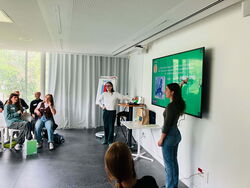
On the first afternoon of the programme, participants visited the cultural institution Lieu d’Europe, a place dedicated to information, dialogue and education about Europe. Through the EuroQuiz, they deepened their knowledge of European history and its close connection to Strasbourg in an engaging and informative way. The afternoon concluded with a boat tour on the River Ill through the Petite France district, the Neustadt and the European Quarter. Passing the buildings of the Franco-German cultural broadcaster ARTE and the European Parliament, participants gained valuable insights into Strasbourg’s European significance. Following the Second World War, the city became the seat of key European institutions and a symbol of reconciliation. A language café followed by a games evening also provided an opportunity to engage in conversation, practise language skills and get to know one another better in a relaxed atmosphere.
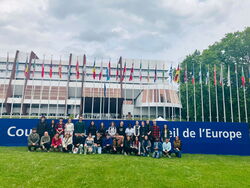
On the second afternoon, participants received a guided tour of the hemicycle of the Parliamentary Assembly of the Council of Europe and attended a conference on the New Democratic Pact for Europe, which focuses on strengthening democratic values in the face of current challenges such as disinformation, authoritarianism, democratic backsliding and artificial intelligence. Afterwards, participants took part in a scavenger hunt through the European Quarter in Franco-German groups. They discovered Strasbourg’s three most important European institutions – the Council of Europe, the European Court of Human Rights and the European Parliament – and explored how the architecture of the buildings reflects their functions and significance.
“The excursion I enjoyed the most was the visit to the Council of Europe, where we met a deputy of parliament and were even able to have a short discussion in one of the plenary chambers.”
Kai Ritter – Karlsruhe Institute of Technology
In the evening, attention turned to the topic of migration in Europe. Following a screening of the documentary Fuocoammare, par-delà Lampedusa (Fire at Sea) by Gianfranco Rosi and Pietro Bartolo, participants took part in a discussion moderated by Strasbourg’s Eucor doctoral ambassadors Frédy Abadassi and Arman Martirosyan. Together, they reflected on the humanitarian and social challenges associated with migration.
Literature in European dialogue
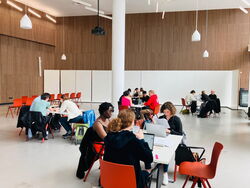
The third afternoon was dedicated to literature. In cooperation with the Department of German Studies, students and doctoral candidates participated in a literary workshop entitled “Beyond Borders: Writing about the Other. Franco-German Dialogues and European Ways of Writing”, led by Aurélie Le Née and Isabelle Schaller. Working in culturally diverse groups, participants reflected on selected excerpts from works by Heinrich Heine, Stefan Zweig, Robert Menasse, Anne Weber, Emine Sevgi Özdamar, Simone Veil, Tomi Ungerer and Georges-Arthur Goldschmidt. They discussed literary representations of the Other, different perspectives on Europe, the European idea, and questions of European identity in and through language.
European defence cooperation in practice
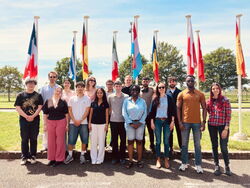
The penultimate afternoon focused on a highly topical issue: security and defence in Europe. One group visited the multinational headquarters of the Eurocorps, whose framework nations are Germany, France, Belgium, Spain, Luxembourg and Poland, while the other visited the headquarters of the Franco-German Brigade. The visits focused on the history, mission and functioning of both institutions, as well as their role in the context of changing geopolitical conditions. Participants also gained insights into the Eurocorps Translation and Interpreting Department, which plays a key role in ensuring multilingual cooperation within the multinational structure.
“I particularly felt part of a European exchange whenever we naturally switched back and forth between German and French, and sometimes English as well.”
Elke Neumann – University of Freiburg
Experiencing languages and cultures, shaping Europe
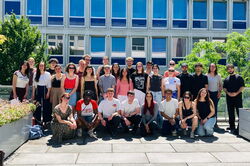
The final afternoon provided an opportunity to look back on the week together and to reflect on what each participant would take away from the experience. Isabelle Schaller, organiser of the exchange week, emphasises: “The language and cultural exchange in Strasbourg clearly demonstrated how diverse and enriching direct interaction between people from different countries and cultures can be. The combination of language, culture and academic exchange made Europe tangible through shared experiences. The week created lasting momentum for academic cooperation and highlighted the value of European understanding in everyday life.”
Von: Isabelle Schaller