KIT Spring Academy 2026: Sustainability in Practice
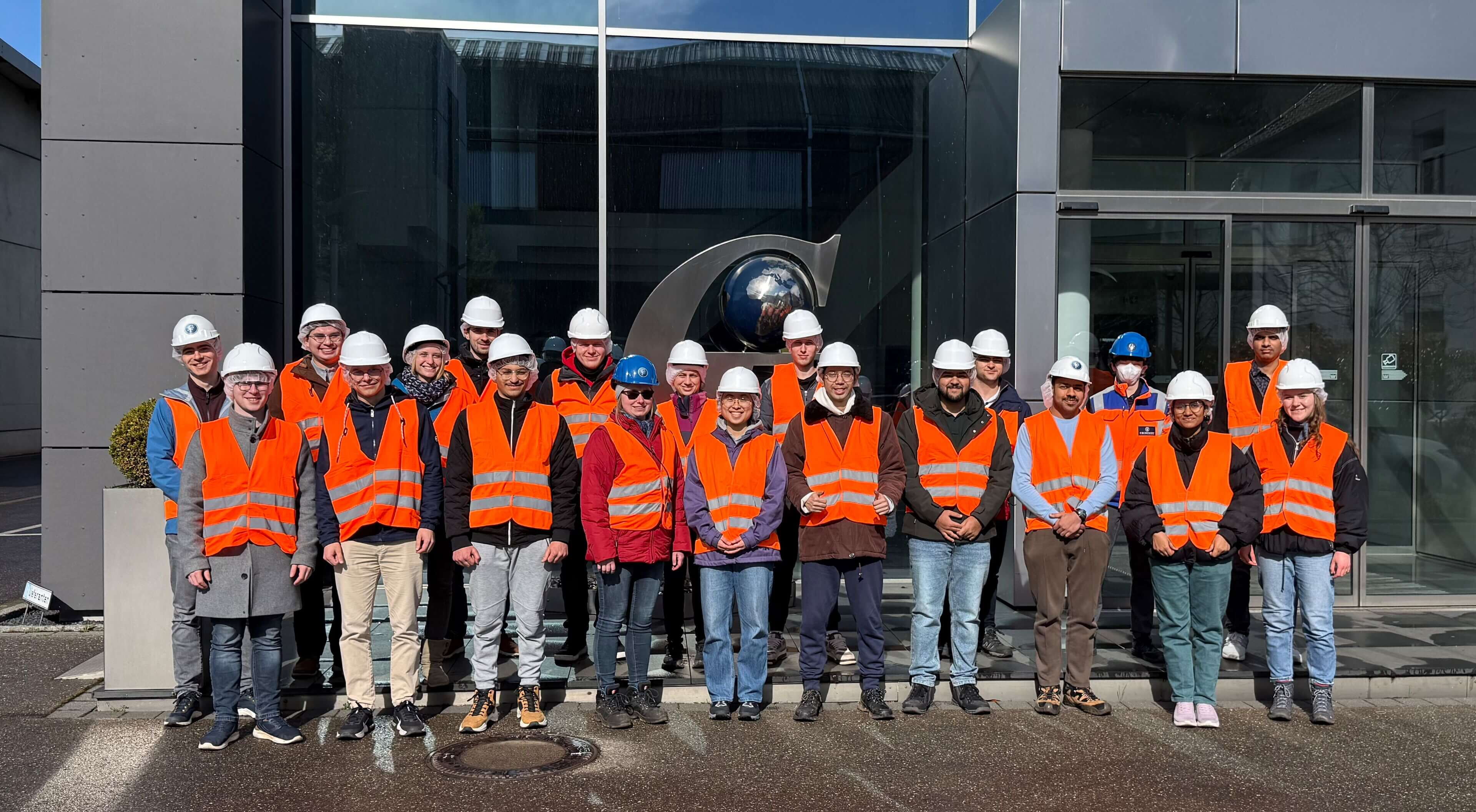

Between lecture halls, workshops and lively discussion groups, the Karlsruhe Institute of Technology (KIT) spent a week focusing on sustainable development and the circular economy. The occasion was the Spring Academy Sustainability 2026, which is held once a year by „General Studies. Forum Science and Society (FORUM)“ at KIT on a key topic. In 2026, the Spring Academy also took place as part of the tenth anniversary of the EGTC Eucor – The European Campus. Throughout the programme of the Spring Academy Sustainability, students and lecturers from the Eucor universities , together with about 200 participants in total, addressed the question:’ What is a sustainable circular economy? ‘. Sustainability did not remain an abstract concept, but was discussed in practice-oriented workshops for various areas and replicated in case studies. Sustainability and the circular economy were also experienced directly outside the seminar rooms, for example during a total of 16 excursions. Lea Engelbrecht from Strasbourg took part in an excursion and looks back for us:
During one of the excursions proposed to the students, I could witness for myself how concepts and objectives – for example in the context of the Paris climate goals– are implemented in practice. The events were not only open to KIT students, but were also accessible to students from the four other Eucor universities. I then took advantage of this and traveled from Strasbourg to Karlsruhe, more precisely to Karlsruhe's Rhine port, to visit the CRONIMET company and investigate how the circular economy works practically on site – or in other words: how scrap gets back to the steelworks.
The visit at CRONIMET highlighted the complexity of the path to a functioning circular economy. Founded in Karlsruhe in 1980, the company specializes in metal recycling. Precisely processed raw materials are created from seemingly worthless scrap. Above all, stainless steel scrap is collected, sorted and returned to the production circuit. The materials are separated according to their qualities, crushed or shaped as needed and finally passed on to steel mills or foundries where they are recycled into „new“ stainless steel. Thus, CRONIMET is part of a value chain aimed at using resources for as long as possible.
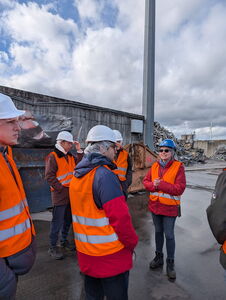
The excursion was divided into three parts: First, Dr. Michaela Lindemann, Innovation and Technology Manager, explained the basic relationships between metal recycling and processing at CRONIMET to the students. Equipped with this information and questions for the tour, we then went to the yard to observe the aspects discussed in practice. The tour was followed by an overview of the sustainability program and an insight into the implementation of such a program based on the presentation of measures that have already been implemented and are planned for the future.
The concept of recycling is already based on a sustainability concept, but the question of sustainable development naturally also arises with regard to the use of energy and resources in one's own operations. At the Karlsruhe site, CRONIMET relies on an energy monitoring system, the gradual electrification of machinery and vehicles, and long-term climate goals. During the field trip, students were able not only to gain theoretical insights into the sustainability program, but also to observe two all-electric excavators in action on site.
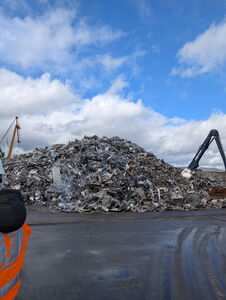
As Isabelle Nischk, Innovation and Project Manager for Electrification, and Katharina Schmidt, responsible for Climate Strategy, explained, electrification brings several strategic benefits: environmental protection is both an internal priority and an increasingly demanded standard of customers and end consumers. At the same time, the switch to electrically operated machines significantly increases the service life of the devices. „Compared to our previous machines with diesel engines, electrically powered excavators last twice as long“, Isabelle Nischk explained clearly. The experts also dispelled the prejudice that environmentally friendly technologies inevitably entail higher costs. The opposite is true: the longer service life and lower operating costs can save costs in the long term.
The field trip at CRONIMET enabled the participants of the Spring Academy to observe the operational processes up close and ask their questions directly on site. In this way, it became clear how concepts such as the circular economy and energy efficiency are implemented in practice and what various factors play a role in this. Through application-oriented excursions such as these, together with the scientifically anchored workshops and interactive discussion rounds, the Spring Academy for Sustainability at KIT provided access to the complex question of a sustainable circular economy.
By Lea Engelbrecht