Border regions as a driving force for European university cooperation
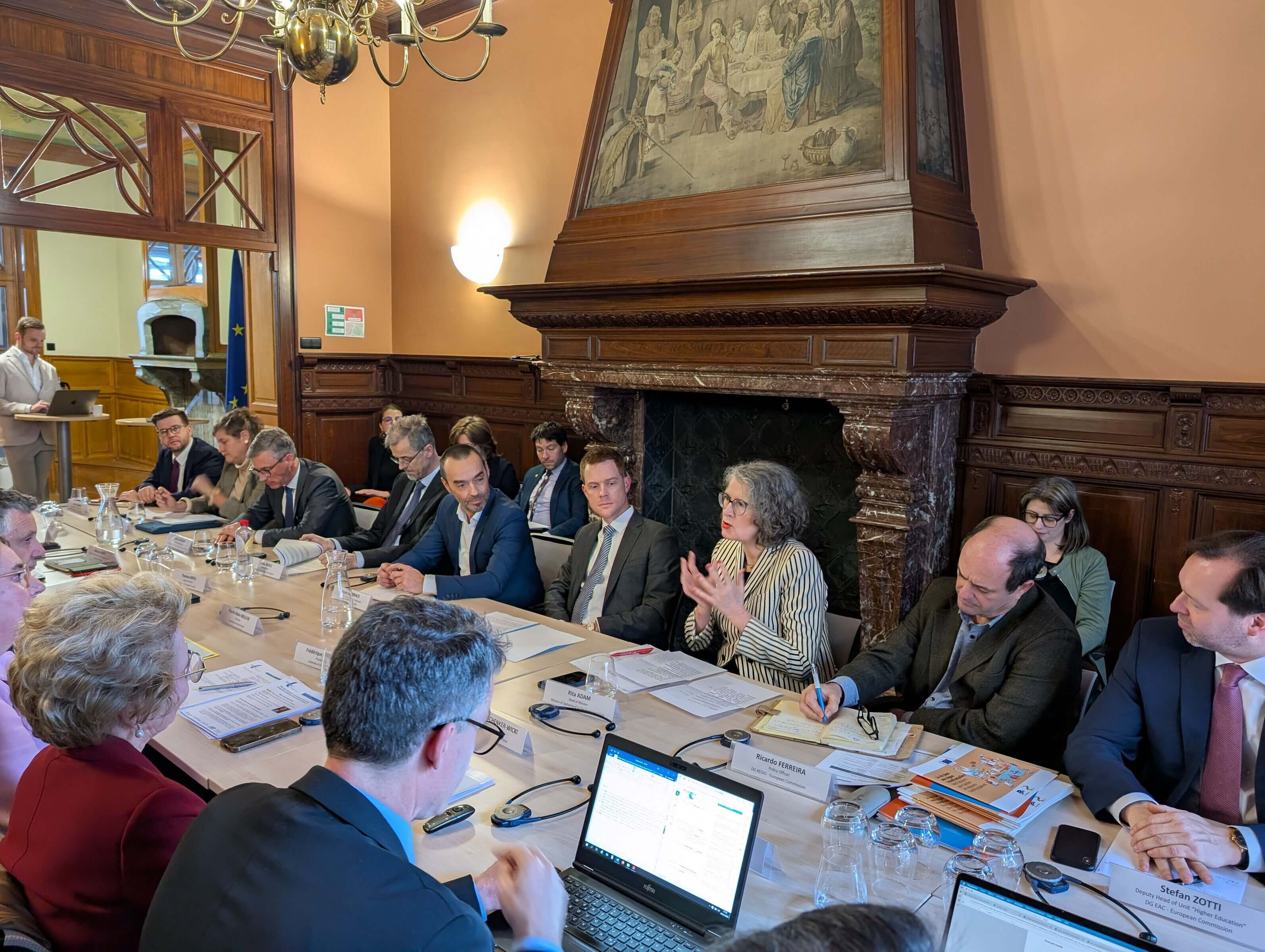
At the invitation of Eucor – The European Campus, representatives from European institutions, countries and regions met with the leadership of the Eucor universities on 5 March 2026 at the premises of Grand Est Europe in Brussels for an expert discussion. As part of the EGTC anniversary, they exchanged views on the future of cross-border university cooperation in the European Union (EU). The discussion focused on how regional university alliances such as Eucor can contribute to the further development of the European higher education and research area.
Connecting different EU policy areas effectively
A key topic of the discussion was the interaction between different EU policy areas, particularly research, education, innovation and regional development. Cross-border regions in particular illustrate the opportunities that arise when programmes and initiatives are not pursued in isolation but are interconnected.
Eucor demonstrates how universities cooperating across borders can combine existing EU programmes (Horizon Europe, Interreg, Erasmus+) and thereby develop new forms of collaboration. This shows that the programmes already interact positively, while at the same time there remains a need to further simplify and coordinate the interfaces between the different initiatives.
Participants emphasised that, in the future, it will be crucial not to view and further develop individual programmes in isolation, but rather to align EU policy areas more closely so that innovation and cooperation on the ground can be supported as effectively as possible.
Border regions as spaces for European innovation
Using Eucor as an example, it became clear that cross-border cooperation often serves as a pioneering and experimental space for European collaboration. New forms of cooperation frequently emerge at the regional level through practical experience: universities, regions and political actors jointly develop solutions to questions arising from cooperation between different national systems, for example through Eucor’s cross-border professorships, which are breaking new ground in Europe.
In addition to financial support, the removal of legal and administrative barriers was therefore also identified as an important factor in further strengthening such cooperation.
Participants also underlined the importance of the regional dimension within the European Higher Education Area. The European added value often arises precisely where institutions from different countries work together in their everyday activities. Border regions are therefore key places where European integration is shaped and further developed in concrete terms. Eucor illustrates how such cross-border alliances can provide tangible impulses for European innovation and cooperation at the regional level.
Participants
Rita Adam, Melanie Arndt, Brita Bamert, Thomas Bautz, Frédérique Berrod, Klaus Boehle, Gaëtan Claeys, Carlo Crameri, Anne Cudel, Ricardo Ferreira, Bernd Finger, Marc Frick, Sandra Gillner, Astrid Hannes, Thomas Hirth, Mathilde Jacq, Christian Jäger, Bodo Lehmann, Virginie Manfroni, Markku Markkula, Sabine Menu, Antoine Mercier, Eric M. Miller, Pierre-Alain Muller, Pascale Nachez, Frank Petrikowski, Jean-Marc Planeix, Felicitas Proksch, Andrea Schenker-Wicki, Bruno Tobback, Stefan Zotti